

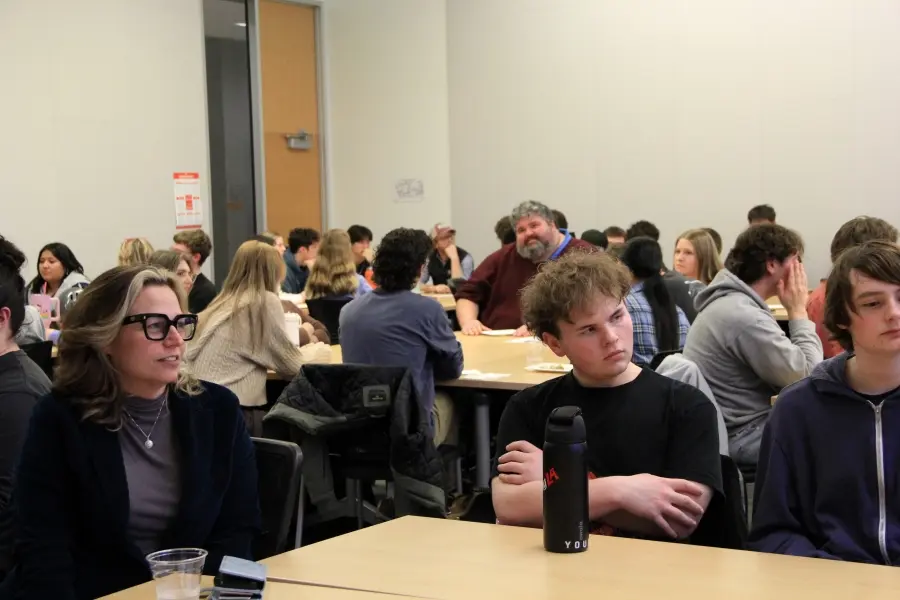
Dozens of students packed rooms filled with lively dialogue about some of the topics that make people grimace at the Thanksgiving table — from political issues and free speech to the justice system — sharing their viewpoints on major issues of the day while remaining respectful throughout. The Oregon State University College of Business Discourse Program intentionally encourages challenging conversations by tackling difficult topics at a discourse event each term, where students openly share their thoughts and opinions on contentious issues in moderated debates.
Past events have spanned topics ranging from whether public camping should be illegal to conversations about what people owe their political rivals.
The Discourse Program also hosts talks and discussions with prominent figures, including Nadine Strossen, former president of the ACLU, and diplomat Dennis B. Ross, who served in several capacities as an adviser focusing on Middle Eastern policy under U.S. presidents George H. W. Bush and Bill Clinton and Secretary Hillary Clinton.
The program began two years ago amid efforts from the Sara Hart Kimball Dean of the College of Business, Tim Carroll, to elevate dialogue around civil issues on campus. Business instructor and co-lead of the discourse program James Taplin stepped in to guide the effort and says the program “is completely student-driven, with students choosing topics for discussions and debates, organizing events and leading conversations.”
“We participate in conversations about ideas,” Taplin said. “A working democracy requires engagement and a willingness to consider different perspectives. Hearing every view, understanding differing perspectives and having the courage to say, ‘I really think you’re wrong,’ is essential for our country.”
The events draw a large turnout, with over 70 students attending discussions and over 800 attending larger speaker events.
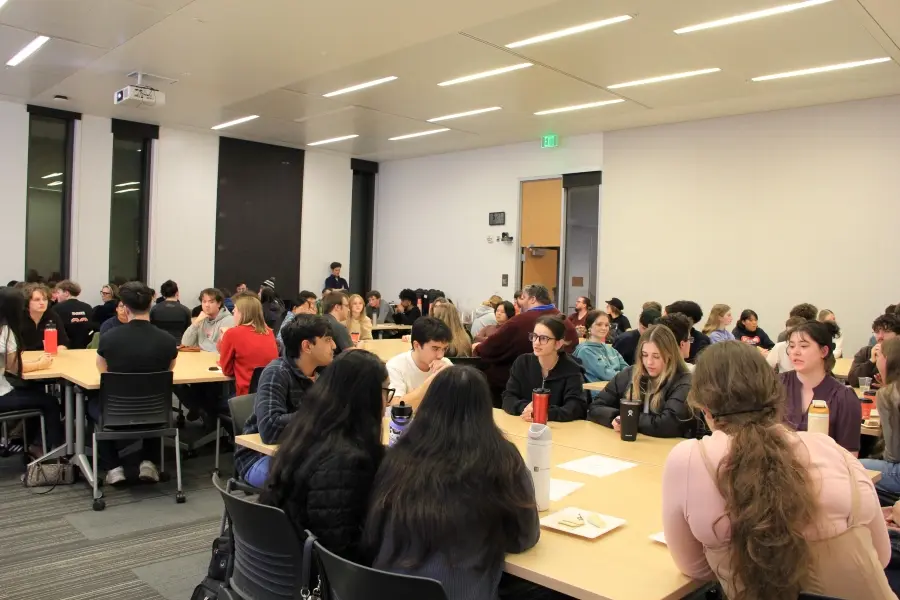
This year, a number of events have been hosted by the discourse program, some of which were also hosted in conjunction with the Honors College. In the fall, they examined topics including "When is Political Violence Necessary?" Students discussed how they define 'political violence' before presenting prepared speeches, debating one another and sharing their perspectives. In the winter, the group hosted "Scholars or Suckers: Is Higher Education a Swindle?” in conjunction with the Center for Teaching and Learning, where students grappled with issues surrounding student-loan debt, wealth inequality and the value of education in small-group discussions moderated by discourse students. In the spring, the Honors College, College of Business Discourse Program and Darkside Cinema partnered to present the film “If Beale Street Could Talk,” followed by a discussion panel with OSU faculty and staff examining themes of incarceration, false imprisonment and the experiences of marginalized communities in the judicial system.
Taylor Maki, Honors College student engagement and recruitment coordinator, initiated collaborations between the College of Business and Honors College for civil discourse events and emphasized their role in creating spaces for meaningful dialogue.
“The Honors College participates in events like the Discourse Program series because it aligns with our college’s values,” Maki said. “Students are navigating increasingly complex times, and these events help support them in that process. Partnering with the College of Business Discourse Program provides a platform to explore topics that can feel difficult or uncomfortable.”
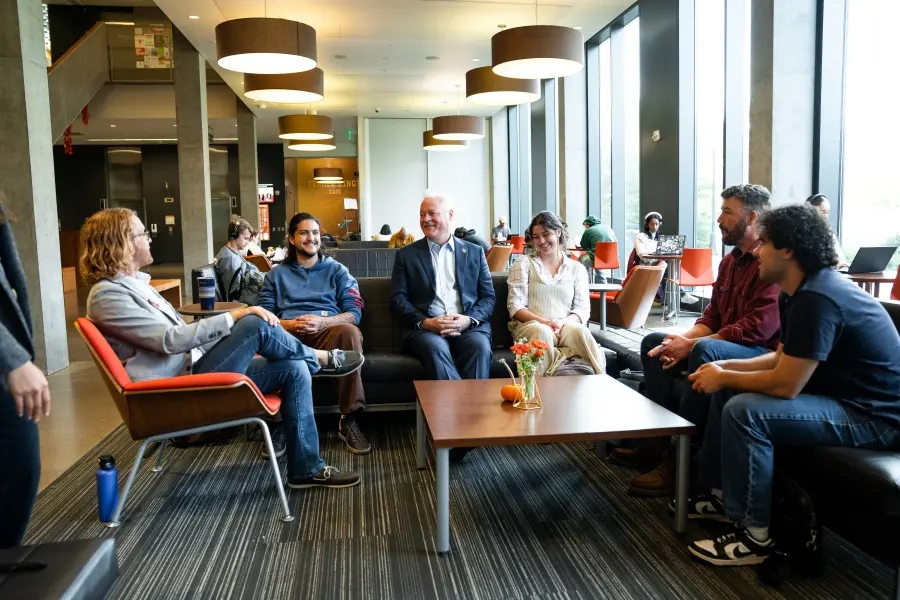
coordinator Johnny Rogers, OSU Alumnus Ethan Jones, College of Business Dean Tim Caroll, student Hadley Kuosman, College of Business instructor James Taplin, and student Axel Lopez meet in Austin Hall to discuss civil discourse events.
Fourth-year business administration student Severyn Pavlyk joined the group after hearing about it in one of Taplin’s classes two years ago. Now an organizer and facilitator, he says that “at the start of events, students can be quiet and reserved,” but after an atmosphere of trust is established, “the conversation picks up.”
“Somebody says something a little daring, and then the next person says something daring,” Pavlyk said. “It prompts others to realize they can open up here. Politics can feel deeply divisive, but after sitting next to someone you disagree with, shared values often emerge. Creating lines of communication helps bridge divisions that feel especially prevalent in the United States.”
For members of the Discourse Program, involvement provides opportunities to engage in challenging conversations, create inclusive spaces for campus dialogue and build community.
“We’re basically a group of friends with professionalism still present, having conversations that we're too shy to talk about elsewhere or feel societal pressure to keep quiet about,” Pavlyk said. “Having a space where we feel like we can have hard conversations has had a positive impact on all of us."
Zach Martin, a fourth-year honors student majoring in history and religious studies, became involved in the Discourse Program after Maki encouraged him to participate. He has spoken at events, including delivering a prepared speech during a debate on political violence, and helped moderate discussions at the discourse event focused on higher education. He says the events “have had great turnout and discussion.”
“Having uncomfortable conversations is important,” Martin said. “Having a debate, disagreeing, and walking away civilly with one another afterwards has become less common in the internet age, and I admire any organization that's trying to build our conversation muscles. That’s why I stay involved with the program.”
Students interested in joining the Discourse Program or attending upcoming events are encouraged to follow @oregonstate.discourse on Instagram. The group meets twice a week. Meetings take place Mondays at 10 a.m. at the Austin Hall Marketplace for casual conversation, discussion of current issues and event planning. On Fridays, students gather from noon to 1:30 p.m. at MU Lanes & Games for a bowling social.
All OSU students are welcome to participate. Upcoming events include a conversation with Jessica Riedl, a researcher and budget and tax fellow at the Brookings Institution, on May 21.
By HC Student Writer, Montana Burack