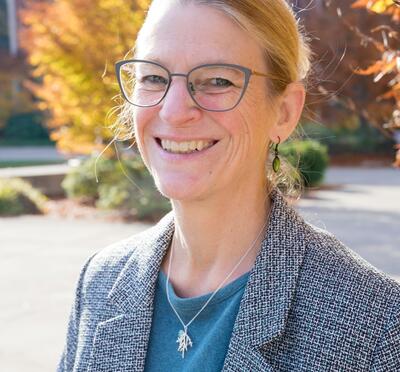
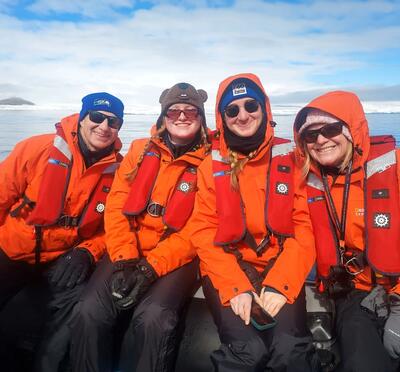
During his time as an undergraduate in the Honors College, Tyler McFadden, ’15, began exploring questions about ecology and biodiversity — questions that would shape his academic and professional path for years to come. Now an instructor and interim director of the environmental sciences undergraduate program in the College of Earth, Ocean, and Atmospheric Sciences at Oregon State University, McFadden continues to pursue interdisciplinary approaches to environmental challenges.
McFadden graduated from Oregon State University in 2015 with an honors bachelor's degree in fisheries and wildlife sciences. He later earned a Ph.D. in ecology and evolutionary biology from Stanford University, building on the foundation of fieldwork and research he began as an honors student.

His interest in ecology developed early. “Before my thesis research, I got a position as a field assistant in the Yucatán Peninsula in Mexico to help out with research on an endangered bird called the Yucatán wren,” he says. Fluent in Spanish, McFadden was drawn to Latin America’s diverse biomes and endemic species. He also studied abroad in Chile during a faculty-led trip. “By the time I was seeking a thesis mentor and topic, I was excited about ecology — and birds in particular. I wanted to get involved in research somewhere Spanish speaking.”
McFadden connected with J. Boone Kauffman, a faculty member in the College of Agricultural Sciences’ Department of Fisheries and Wildlife, and one of his instructors. Their conversations led to a project focused on nutrient dynamics in mangrove ecosystems. “In the end, I was really excited about my topic of how birds affect nutrient dynamics within mangroves,” McFadden says. “Colonies of waterbirds nest in the mangroves and go out to forage and catch fish, so I wanted to see how the impact of these nutrients played out across this interface between marine and terrestrial ecosystems.”

His honors thesis, titled Effects of nesting waterbirds on nutrient levels in mangroves, Gulf de Fonseca, Honduras, explored this dynamic in depth.
That conversation also led to a summer fieldwork opportunity in Honduras, where McFadden joined Kaufman’s research team. “That allowed us to start having a more concrete conversation about what my role would be and whether there would be space on the project for me to work on it,” he says.
While in the field, McFadden began collecting data for his honors thesis. “I put out some collection devices for collecting bird guano along with additional measurements of nutrient content like phosphorus and nitrogen in the soil and the mangrove leaves. Then we sampled an adjacent control site that didn't have a bird colony and came back to the lab to understand how those birds were affecting nutrient dynamics.”


He describes the experience as foundational. “Later on, when I was applying to Ph.D. programs, I could talk about how I’d done a research project from start to finish,” he says. “It was an incredibly valuable experience.”
McFadden also credits mentorship as a key part of his academic journey. His honors thesis mentor helped him “learn how to conduct research in international settings” and connected him with collaborators who supported his graduate work.
Since joining Oregon State in 2022, McFadden has mentored Honors College student Abby Luna, ’24, through the URSA Engage program. Her research — now an honors thesis titled The Bird Gap: Using U.S. State Birds as Indicators of Climate Impacts and Nature Access Across Racial Groups — examines how climate change may influence access to birds across different communities. “From a mentor perspective, it’s really fun to work with students who are working on their first research project,” McFadden says. “I think that students are used to learning about things that have already been done. But an undergraduate research project like the honors thesis allows them to create new knowledge and answer questions that we don't know the answers to. And it’s a really rewarding process.”

McFadden’s work in the College of Earth, Ocean, and Atmospheric Sciences offers a wide range of research opportunities. “Within CEOAS, our area of strength is studying large scale environmental challenges from an earth systems perspective,” he says. Research centers on pertinent topics like climate change, biodiversity loss, ecological restoration and drought and incorporates interdisciplinary approaches, he explains. “Students can look at these problems from a viewpoint of science as well as the humanities. It’s a thrilling place to be and holds a lot of opportunities for undergraduate students.”
For students beginning their own thesis journey, McFadden encourages embracing the unknown. “You don’t have to have all the answers when you start,” he says. “The process itself teaches you how to ask better questions.” Whether in mangrove forests or campus labs, that curiosity continues to shape the way McFadden approaches research — and the way he mentors others to start their own journeys.
Written by Shion Britten, HC student writer
Related Stories