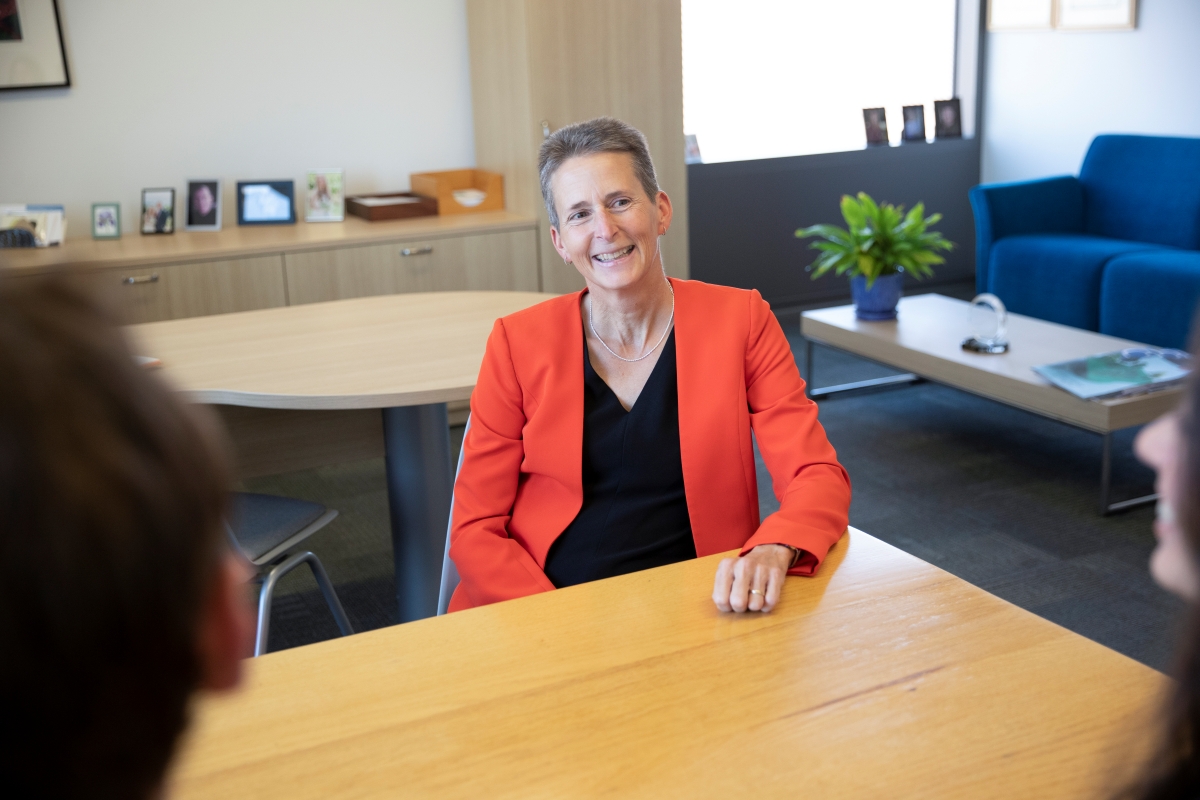
Toni Doolen sat down with Honors Link to talk about her tenure as dean of the Honors College. This interview has been edited for length and clarity.
Q: Is it unusual to have an engineer serve as an honors dean? Don’t most honors deans come from a liberal arts background?
Many of my dean colleagues do come out of the liberal arts and occasionally the sciences. Some people still use the language of honors is like small liberal arts college in a research university. We never use that here, because it’s never been our model. We weren’t designed that way.
Q: So this, this background you had, working in industry as an engineer…
My undergrad degrees are electrical engineering and material science and engineering. So I worked as a process engineer in semiconductors [at HP]. Our facility was research and development and manufacturing, and so I got really interested in some of the more logistical things, like why we couldn’t get material out the door on time. So that led me to a master’s in manufacturing systems engineering, but I didn’t do industrial engineering until I did my Ph.D. So I never was an industrial engineer in industry. After my PhD. I came onto the faculty, but I had worked in manufacturing facilities where there’s lots of industrial engineering types of issues.
Q: Some of your colleagues in the Honors College mentioned how you brought a little bit of an engineering mentality of efficiency and getting things done, thinking strategically about process. How did you look at the process and structure to expand the Honors College to OSU-Cascades and Ecampus to continue to have that capacity to offer the classes, have the mentors available and deliver the honors experience?
I will say that all my engineering training really leads you to ask different sorts of questions. I mean, fundamentally, engineers are about problem solving and design. That’s just how I do things. Not just in honors colleges, but in administration in general, the work we do, they are all processes. But the way I think about it is like a flow chart. What’s the beginning, the end and what’s in between? What are the decision points? What are the actual process steps? Where is data needed? That is just how I view the world. I even view things I do in my personal life in the same way.
Q: Once you have that mentality, it’s kind of hard to step out.
I wonder if you have the mentality first, and then you find a field that takes advantage of that, or does your field inform your mentality? I don’t know. It may be a little bit of nurture and nature.
Q: One of your faculty members talked about how you would run a meeting. It was efficient and on task, but you also made sure that everybody’s perspective was heard, that everybody had a voice. And that’s a delicate balance. How do you get things done while making sure that everyone has a voice and a say in the discussion.
There are two pieces to that. The Honors College Council is a great example. It’s so valuable to the college to get faculty and student’s perspective. But we never go into an HCC meeting without an agenda, and the agenda has times attached to it, so that kind of serves as your guidelines.
But the other thing I know is that, when there are decisions to be made or votes to be taken, sometimes we come into the session thinking we kind of know what the outcome is, but then through the course of the discussion, you realize that’s not the case. So part of it is going into any meeting with an understanding that you could push something on the agenda to the next conversation so that we can take time for this meatier conversation.
The other thing I will say is, what makes organizations great is not their building. It’s not their processes. It’s not equipment. It is all about people. I was so fortunate to start at a company like Hewlett Packard, where, when I was there, it was so clear from Bill Hewlett and Dave Packard that people were the essence of an organization. All the managerial training that I was fortunate enough to receive when I was at Hewlett Packard, and then in the course of my engineering management studies, with my industrial engineering focus, was about understanding the role of people in making organizations happen.
And so the most important thing to me at all times, even when you’re dealing with performance issues, when you’re dealing with a crisis or with budget challenges, people have to come first. You can get rid of or change all those other technical parts of your system, and you can still be effective. You can’t without the people.
So if we are having a meeting, it’s because we want to get people’s perspective, and nothing is more important than that. Now, the agenda is important because you’ve got decisions to be made, but part of your role as a leader is knowing what has to be done in this moment, what things you can go ahead and make more time for or have more conversations about. And then I think you adjust your approach based on that.
It’s giving people space, giving people agency, and then really listening. And not just listening to what they say, but what they don’t say. That’s the thing that allows us as leaders to really have a handle on what’s going on. The higher you are in an organization, the less likely it is that you’re going to get critical information about what’s really happening. So it’s important to create the time and space for that.
I think about Honors College community coffees. We provide coffee and snacks for students to bring them in. Those are huge for me, because I hear from students — unfiltered — what’s going well, what’s not going well.
So yes, you have an agenda. Yes, you need decisions made. But there are times when, as a leader, you have to realize, “Wow, there’s actually more energy around this than I would have thought. We need to take some time.”
Recently, we did a major restructuring of our curriculum, the first one in almost 30 years. With the transition to Core Education, it became apparent that there was lots of interest in that conversation, lots of different opinions. So we spent an entire summer working offline with faculty so we could come back with something more robust to the Honors College Council.
Similarly, we’re in the process of potentially adding a microcredential, which I’m super excited about. And originally, I was thinking about other types of alternate credentials, like minors, options, certificates, and it was because of really meaty conversations with faculty and also the registrar and then understanding what options are out there that we decided that a microcredential makes a lot more sense for us. That is not where I started. I thought the solution was going to be something else, but if I hadn’t had relationships with people, couldn’t have some robust and meaty conversations like, “Tell me the difference.” “What makes this not workable?” “What will make this something we could actually get approved?” And then understanding from the faculty, alumni, Board of Regents, “What are your concerns about this alternate credential?” “How do we mitigate those risks?”
So I could have made a decision and just try to push things through, but that doesn’t make sense. People had so many good perspectives to share that weren’t the same as my perspective. And we’ve ended up, both in the new curriculum and hopefully this effort to get these two microcredentials approved, with what I think are brilliant solutions. But that is because the process is really believing that other people who are stakeholders have important opinions to offer that should be integrated into the decision.
You can be in an organization a really long time. I have lots of knowledge and lots of history, but I don’t know all the answers. And I think, for me, that value we create is so much better when it’s multiple people involved. But then I studied teams as my dissertation.
Q: Circling back to the coffees you have with students. Do they feel comfortable being brutally frank with you?
Oh, yeah. The lovely thing about the Honors College and us being undergrad focused is that students have no idea what a dean is. I’m Toni. I’m the one who welcomes them at Convocation, I show up at graduation, and I’m at these coffees. I ask, “So tell me about your honors classes.” “Where are you at with your honors thesis?” “What’s going well for you?” “What’s not going well?” And they just share.
There was a point 10 years ago, when we knew we had to change differential tuition. We were in a really difficult position financially where we could decrease the number of classes, increase class sizes, increase differential tuition or implement a mix of those things. And because of how differential tuition is set, I understood that students were an important part of that process.
So we did all these listening sessions. And for me, that was a transformative time, because I was still pretty early on in my time as honors dean. I thought, “Wow, this is a perspective and a voice that’s super critical to this decision.”
Now, was it hard? We got some not-very-nice letters from parents and students who were upset that we were increasing tuition. But it also felt really good that the decision we made was largely informed by the students saying that substantially increasing class sizes or reducing the number of classes would take away from the experience. So what they told us was if you have to increase differential tuition, do that, but then make sure you have scholarships available for the students where this becomes a go, no-go decision, like having to leave the college. Would we have gotten that perspective on our own? Maybe. Eventually. Sometimes difficult conversations — robust, authentic, genuine conversations, especially when they include what could be construed as criticism or not being happy in the moment — that’s not always the most exciting to hear. But then being able to take it, process it and determine how we move forward for the organization, it’s much better.
Q: So it’s not always going to be sunshine and rainbows.
Absolutely, and especially when you look at honors in particular, the amount of growth we’ve gone through. We’ve had changes in staff. We’ve had three location changes. We’ve had budget cuts. It’s all manageable, but it can be hard.
But I think you always start with the one part of the organization that you can’t replace — the amazing and committed people. And so people first is what it really means, at least from my perspective, when we say at OSU, our students, our employees, are central. I would like to think if anybody said what my core values are, that would be it. And then being transparent, making tough decisions when you have to. Being honest, because sometimes the news you have to deliver isn’t great news. I believe those are critical, and that is to me, what good leadership looks like.
Q: Is there anything else about your engineering background that impacts your leadership style?
I don’t know if this is engineering, but one of the things that’s always been important to me is using data to make decisions. And I’m a researcher who uses a mix of qualitative and quantitative data. So when I say data, I don’t just mean numbers. Frankly, comments on students’ evaluations are sometimes more useful than the numbered rankings.
I approach our operations the same way. We invested a long time ago in a robust enterprise resource management system. I think a lot of people couldn’t understand why I did that, why I prioritize having folks with really strong data analytical skills on the staff. But it’s because if we don’t have data, it is hard to make good decisions.
And when we go to the Honors College Council, and we present something like we believe that it would be in the college’s best interest to allow students who don’t meet our minimums to still have the opportunity to apply, we can say, “Here are the data. Here’s what we learned in Covid. Here are the pros and cons.” So to me, I think, as an engineer, making decisions with quantitative and qualitative data is way more sensible.
If I have data, it might be I’m wrong, but I think about our growth. How many people do we need to admit to hit the target? And when we miss that either high or low, what adjustments do we need to make? So I think my engineering training makes it important to me that data informs what we do, and again, in no way discounting qualitative data. Sometimes numbers hide the root of what’s there.
Q: So when you took on this job, did you set any goals for yourself as a dean, for the Honors College in general? What were your goals coming into this?
When applying for the dean’s position, we were all asked to do a presentation about our vision for honors. My goal then, which in many ways, is similar to our just recently released strategic plan, was personalization of transformative experiences at scale. And I used different words 15 years ago when I interviewed because the way I can think about it is more nuanced and complex now than I could have back then. But that was really it.
As an undergrad, I participated in research, and it was transformative for me as a first- generation student. And I think my undergrad experience and understanding how life-changing an undergraduate degree can be, not just for an individual, but to their entire family. That’s what really shaped my affinity toward honors education at public universities, because that is what we’re about.
And I’m not saying the rest of the university doesn’t prioritize that. They do. But the approach of connecting students to the research side of an R1 university is really important to me, so figuring out how to do that at scale, figuring out how to do that for all types of students — Ecampus, OSU-Cascades, Corvallis, high-needs students, first-gen students, engineering students, liberal arts students — that is what resonated. And so I think, at the highest level, the things I’ve been working on are the things that drove me to first become associate dean and then make the decision to apply to become dean of the college.
And we’ve made progress. I’m super proud of having so many of our students who have needs, like financial needs, still able to do honors. Do we have work to do? Oh, yeah. Lots more. What we’ve achieved from where we started, I couldn’t have dreamed of, but some pretty amazing people I’ve worked with along the way made that happen, both OSU people and our Board of Regents, our Parent and Family Leadership Circle, Alumni Leadership Circle, the various student leadership circles, people who cared deeply and were willing to invest their time and energy.
Q: So many times when we’ve talked, access was so important, was such a priority. For Ecampus, most of those students never thought that an honors experience would be available to them because they’re nontraditional students. To have that opportunity, to meet the needs of those students, because they are very different, but you’re making that effort. That’s huge.
And I think we have lots of opportunity there. We’ve had just two so far, maybe we’re up to three who are Ecampus students graduate with their honors baccalaureate degree. The first one did a lot of their coursework in Corvallis, and then circumstances changed — they moved — and they were able to graduate shortly after the Ecampus degree was approved without having to come back to Corvallis to finish their classes.
The student I met this spring at our graduation reception is just a lovely story. It was super important to her to do the honors degree, to have this opportunity to do research, which substantially changed what she’s going to do subsequently. It’s hearing that story. That’s exactly why we wanted the access to be there. It’s really heartwarming.
Q: At Ecampus, they love it when their graduates come for Commencement, and it’s the first time they’ve set foot on campus. They’ve come from across the country, and they want to be here for that. It’s meaningful to them, and it’s kind of a point of pride for online learning — that our students have such a connection to the place, even though they’re far away, that they want to be here.
When we do our honors networking events, we invite all the Ecampus students who are in the area. And they’re so excited to meet other Beavers. It’s mostly Beaver alumni, and alumni love meeting current students. There’s just something about being in space and time together in person that you can’t replace.
Q: Did you revise any of your goals or your plans along the way?
Oh, absolutely. If you look at our three strategic plans, I would argue that in some ways, we’ve just gotten a lot more clear about what our mission is. The first one would have been 2015 to 2020, then we had a 2020 to 2025, and now we have 2025 to 2030. We were still trying to figure out who we were in 2015 and what our role was. At a high level, it was access to transformative experiences.
To really impact students in our second strategic plan, we realized we had this critical role as a hub of innovation on campus. I think specific examples of that are National and Global Scholarship Advising, in which we were critical in working with a group of campus partners to create that office. OSU had its first-ever Marshall Scholar announced [an Honors College alum]. We’ve had Fulbrights. We’re one of the top producers of Gilman Scholars. It’s a huge impact for the campus.
And that’s not just about honors. It’s how we do things across the institution. We now also house the Design for Social Impact academic program. In 2015, I never would have thought about honors as a hub of innovation on behalf of the university. In 2020, we started to see the possibilities. But it’s really been from 2020 to 2025 and now in our 2025 to 2030 strategic plan, the question is how do we scale and translate those innovations beyond honors. Nothing equivalent to those goals existed in our very first strategic plan.
I look at Prosperity Widely Shared [OSU’s current and fifth strategic plan], and a college strategic plan has to absolutely be aligned and support the university’s. I feel like in our strategic plans, in some ways, they almost were prelude to some of the things OSU is doing.
I think the thing that people don’t appreciate, though, is you don’t get there without the previous strategic plans. And it’s not that OSU’s previous four weren’t good strategic plans. They were appropriate strategic plans for the institution. They fit the scale, scope and capacity for those moments in time. If you look at the three honors strategic plans that I’ve been involved in cocreating, with all our stakeholders during my time as dean, there is a clarity in our current plan that didn’t exist in the first one, but it couldn’t.
Q: We keep hearing OSU is too humble. We have all these great accomplishments. We need to be telling them more.
I think where we have impact is a very complicated and nuanced space. It is much easier to talk about successful athletics than it is to talk about the impact of research that, by its very nature, is really complicated. So I think the humbleness comes from the difficulty of telling our story, because our story has always been around access, our story has always been around research, and those are a lot harder to talk about. Ours is an amazing story. It is hard to tell, and it doesn’t necessarily fit into a sound bite.
In some of the national dialog right now about the value of higher education, it is in part because we’ve not told the complicated story in a way that folks who haven’t had the luxury of being part of a higher education system can easily understand. I think even people who have experienced higher education as an undergrad usually have zero visibility for what a large research land grant is. They don’t know what Extension does. They don’t know what outreach and engagement is. They don’t understand why research is important. Those are tricky stories to tell, and I think in some ways right now, they’re harder than ever to tell.
You look at the work that we do in the creative spaces and in social sciences, like the work happening in the College of Education. They are making discoveries that impact what happens in a K-12 classroom. And most people, have experienced a K-12 classroom. And these are tricky things to talk about, how it’s impactful. They think, “What do you mean? The teacher just should teach reading and writing, and all will be well.” If only it were that simple.
Q: Do you have a favorite memory of working with students during your time as dean?
When people ask me what I most love about being dean of honors, the thing that I most love, and it’s actually one of the hardest parts of leaving, is that my job has me in touch with students regularly, between our student employees, Honors College community coffees, going to thesis defenses, going to the pre-vet scholars dinners twice each year, graduation, Convocation. A lot of my time that was spent internally has these direct connections with students, and for most deans, especially their time with undergrad students, it’s really minimal.
I’m out at send-off events with parents and incoming students. I do the New Student Orientation parent sessions, and I meet students at the Dean and Friends events that we host. I’m always at those, and that’s 20 students and a friend. Those are the highlights for me. I came to higher ed because I wanted to have touch points with folks early on in their development as professionals. And that’s the part I absolutely love.
For the last three years, I’ve co-taught the honors section in the first of a three-quarter sequence for engineering students with Wade Marcum, and they’re some of my most recent fondest memories. I did this coming out of Covid, because I wanted to understand what looked different in the classroom. And even though they were honors sections, we had 90 students the first year. The second year, we had 150 students, and last year we had 160 students. So I’m not talking about a seminar with a few students. I’m talking about an intro to engineering course that was an honors section, so all the students are in the Honors College.
There were so many amazing memories and moments. The design projects the students had to do were really challenging. Watching them step up to that challenge, watching students pass the microphone as they talked about their solutions to things they were working on — I was watching engaged pedagogy happen in real time with 160 students.
A number of the students from the first year were undergrad assistants for the course in years two and three. I was getting to know those students, meeting with them every week to talk about the solutions they were going to deliver. So many amazing relationships, so many students I really got to know. When you have, even in a big course, 10 weeks when you’re meeting with students, you get to know them. Deans don’t normally get to do that. Some deans teach occasionally, but usually it’s graduate courses. Not many go back to teaching freshmen in large courses, and that was really special.
After the first year. I think Wade and I both thought, “That was a lot of work,” and yet we did it two more years. It was really fascinating to be with first-year students and see what looked different. I had taught the intro to engineering course many times before I became an administrator, so I had a reference point for looking at some of the changes that just happened because societal norms change over 10 to 15 years.
But also, I was really trying to understand Covid. These were students who had lost their [high school] senior year or junior year. You learn important lessons in middle school and high school. And when that got changed, it was the rules of social engagement that were really lost.
I’m not teaching this fall, so it comes from a slightly different perspective, but interacting with students in our fall festivities and Convocation and other events, this is the first year, to me, where it really feels like it feels very similar to how it felt before Covid, but it’s been nearly five years since we shut down.
At least in terms of performing at expectations, some of the projects these students have done over the three years, oh my gosh, it’s so impressive. The level of creativity, the different disciplines of engineering (that they wouldn’t even know were different disciplines) that students brought to bear for solutions, how hard students worked on some of these things, that makes me optimistic about the future.
Now, there are things that still worry me. Students really don’t like to read anything. I’m from an age where reading was super important, right? And I think there’s things we need to learn. So there are real positives to skills that are developed because of the reliance on being able to get things online versus having to go to a library and dig out five books. We don’t need to go back to that. But I still think there’s things where we’ll be navigating, obviously AI and where is it good to use AI.
Q: Is there a specific memory or anecdote about working with a student? Have you ever mentored a student through their thesis or anything like that?
I’m having lunch with a student who graduated a few years ago. I hadn’t advised an honors thesis for a long time. The student was one of our really involved student employees who did a lot of different things for us. He was in industrial engineering and convinced me to go ahead and mentor his thesis in leadership development, and it was specific to Air Force cadets. He was in ROTC. It’s been a special relationship, because we did what ended up being great research. It took us a couple years, but it was published in the Engineering Management Journal, which is a peer-reviewed journal where I was an editor for a lot of years. It’s been really cool to watch his career in the Air Force. And even though I don’t have graduate students — your relationships with your Ph.D. students are lifetime relationships — this is kind of the same.
And then, like I said, watching the students who originally took the intro to engineering class from Wade and I, and then became our undergrad assistants, they’re graduating this year. It’s just so cool to watch them go from being in the classroom, then see how amazing they were at supporting other students, to now writing letters of recommendation and helping them network. That’s just the coolest thing. It’s hard for me to have a specific antidote, because frankly, that’s a big part of what I do, and it’s with multiple students. I don’t have any favorites.
Q: Are there questions that you get asked a lot from colleagues and peers at other universities with honors programs? Any insights that you can share from your experience?
I get asked a lot about budget. I’m the lead on a chapter we just finished on financing honors education, which is a deep dive into the challenges of the allocation of resources in an honors context. This is complex, because every honors college and program is structured differently in their university, and every university has different budget models or ways to allocate. And I get asked a ton about strategic planning. I’ve done quite a few pro bono consults working with new deans to figure out how to create a strategic plan. So I think that my strengths are around the administration pieces, finance, HR, operational elements I’ve spoken a lot about, key performance indicators and metrics, data, informed decisions. Those are well-received in the larger community. Maybe it’s because, anecdotally at least, engineering faculty are less likely to be deans of honors programs. So I bring that unique perspective.
Q: What would you say is your most important accomplishment or lasting legacy, and what are you going to take from this experience to your next role?
The most important legacy, the lasting accomplishment, is all the relationships that have been built, and frankly, just helping lots of folks at OSU and outside of OSU become advocates for honors education. I feel like that’s part of what growing has done, the development work that we’ve done. It’s all about having lots of people who can now tell the honors story. So to me that will be impactful for a long time. I’m really proud of the transparent, genuine relationships that I’ve built, and many of the folks I will continue to have a relationship with.
The other thing I will say, the group of people I’ve worked with, oh my goodness. Kevin [Stoller] and I basically started at the same time, me as associate dean, and he in a different role. Gildha [Cumming], who just recently retired. I’ve had three amazing associate deans. Rebecca Lancelin has been here as an advisor the whole time. She will certainly be the longest tenured member. Leanne [Adam] was first on the committee to create what became the Office of National and Global Scholarship Advising. The relationships with students, relationships with faculty that I never would have met staying in my little world in engineering and the staff. Those are the most important things. But it gets back to it’s all about the people.
And then what will I take from the experience. I think the thing that changes you by living in the world of honors is you will never look at the world from a single disciplinary lens again. I’ve had multiple experiences, being dean in the College of Education, helping in budget and resource planning, leading the group that came up with the managerial competency framework, which is really an HR framework, the work we’ve done with admissions, with the living-learning communities.
Most people who are academic faculty never get a chance to work across disciplines, except maybe in their research. But even for people doing transdisciplinary research, what we do in honors is bigger because it isn’t just about the research side. It’s about all the administrative functions that come together. So I think that I have an understanding and an appreciation for all the pieces — both on the administrative side as well as the academic side — that have to come together to do what we do in all three of our domains. Probably the one I’m the least connected to, and even though there’s some real important connections, is the work that’s happening out in Extension and engagement. But a lot of our thesis mentors are faculty in those worlds. So I see the whole university as a faculty member, and the work I’ll be doing in the College of Engineering, I’m confident that’s going to be super, super valuable.
Even though my role is changing, honors will always be part of who I am.
Related Stories