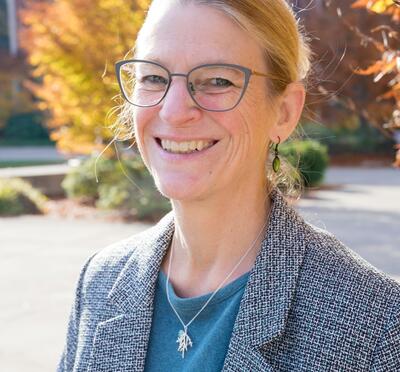
In fall term, 2025, Don Johnson will conclude 25 years of teaching in the Honors College with his final offering of two long-standing colloquia: Leadership and Positive Psychology and Last Year Experience. Both courses prepare students for personal and career success beyond graduation. In his 50 years at Oregon State, Don has modeled this kind of success, serving in diverse roles and taking part in the university’s transformation from a “very good university of 12,000 students into a world-class research institution of over 40,000 students. I’m incredibly appreciative to have had that opportunity,” Don says.

Don’s Oregon State career began in 1976, soon after he earned his M.F.A. in ceramic design in Seattle. “I was originally hired by the Memorial Union to manage the Craft Center and curate the MU art collection, along with teaching design classes in the art department,” he says. His work expanded to student affairs, where he spent the majority of his career in areas ranging from program advising to assessment and leadership development. Throughout his career, Don has also taught communication classes in the College of Agriculture and graduate classes on organizational architecture, among other topics, in the College Student Services Administration (CSSA) program. “I also had the opportunity to serve as project director for the renovation of Weatherford Hall and as interim director of the CSSA Graduate Program,” Don adds. “I’ve been fortunate to learn and participate in many different parts of the university.”
The Honors College brought Don on to its faculty in 2000, when Joe Hendricks, the founding dean of the Honors College, encouraged him to teach a colloquium course. “That was the start, and the number and frequency of teaching honors classes kept growing,” Don says.
Leadership and Positive Psychology was the first colloquium Don introduced. He soon began to co-teach another honors leadership course with John Byrne, who served as Oregon State University’s 12th president and created the Honors College in 1995 (then called the “University Honors College”).
Don continues to offer Leadership and Positive Psychology along with Last Year Experience, which focuses on post-college life. He says that the latter class “came about from a conversation with a student leader commenting on how the university could do more to help students transition into life after college.” Under Don’s guidance, students discuss and gain confidence in topics ranging from personal finance and career navigation to maintaining holistic health.

Don says he is not yet sure what he will miss most upon retirement, “since it will be new to me. But I do know why I’ve greatly enjoyed being part of the Honors College: I appreciate the college’s teaching philosophy, which is completely student-focused and emphasizes the value of diverse student perspectives.” Don aligns with this philosophy by basing his courses around student conversation. “Occasionally, the students become deeply engrossed in a discussion and seem to forget I’m there. Those are my favorite moments — when students share their knowledge and the “ah-ha’s” they achieve throughout their personal development.”
He appreciates how the Honors College supports teaching styles and course topics that facilitate such moments. In line with this, many honors colloquium courses leverage experiential learning through field trips or hands-on projects. However, these courses typically come with additional fees. Don helped to make unique honors course-based opportunities — which range from completing pilot ground school to touring agricultural facilities across the Willamette Valley — financially accessible to any student by directing funds to establish a resource for student payment of course-related costs. Any honors student needing financial assistance for a non-tuition expense associated with an honors course can apply for support from this resource through the Experiential Learning Scholarship.
The funding that established this resource originally came from another program, the Student Development Seminar, which Don administered for 25 years. “When the program concluded a few years ago, we had a balance of funds left in our account and chose to move the funds to the Honors College to directly benefit students.”

This fall term marks his fiftieth year at Oregon State, and Don says “it feels like a perfect time to move on and further develop my career.” He will continue personal research on the influence of AI on career and personal development, a topic which will feature in his Last Year Experience class in the fall. And while Don will no longer hold any formal position at Oregon State, he plans to continue a mentorship relationship with about fifty students he has worked with throughout his career, ranging in age from 22 to 55. “In that respect, I will never truly retire,” Don says.
Related Stories